Tong Ho - Garland Chrysanthemum - Chrysanthemum Leaves

Tong Ho - Garland Chrysanthemum

Names: Tong Ho, Garland Chrysanthemum, Chrysanthemum Leaves, Crown Daisy, Shingiku, Tong Hao, Tung Ho, Tang Ho, Chong Ho, Kor Tongho, Tong Ho Choy, Tong Hao Cai, Thung Ho, Shunigku, Kikuna, Tan O, Cai Cui, Ssukgat, Chrysanthemum Greens

Botanical Name: Chrysanthemum coronarium


Edible tong ho is actually the leaves of chrysanthemum, has an unique taste. For Indonesians who are very familiar with daun kenikir (kenikir leaves - Cosmos sulphureus), tong ho has similar taste to kenikir leaves. In Indonesian cuisine, kenikir leaves are used for pecel (Java style Salad with Spiced Peanut Sauce).

Back to our topic here, tong ho is used to flavor salads, soups, sukiyaki and other dishes. It will be lost the unique taste if you do overcooked or blanch them; I prefer eat them raw.

This leafy green has 3 different sizes, large, medium and baby. The one that I captured on the picture above was the medium leaf. Agrohaitai.com has a depth information on this aromatic leafy.
» Read More...

Cantik Manis - Indonesian Sweet Pretty Cake

Cantik Manis - Indonesian Sweet Pretty Cake


Cantik means pretty while manis means sweet. It's straight forward translated from its name. Even though the name is cantik manis, I reduced the sugar amount from the recipe that I saw in my Yasa Boga cookbook. It's very easy to make, no steaming or baking process. Cantik manis is also popular during Ramadan in Indonesia. Usually, there are evening markets that sold traditional goodies before the Iftar time, so people can buy and bring them for breaking their fast at home or mosque.

Anybody who wants to participate in Joy From Fasting To Feasting (season-III) who is hosted by Lubna Karim, feel free to click the link above. You don't have to be a Muslim to join the event. The more the merrier, don't you think?


Originally, these little cute dessert cakes are wrapped individually in thick plastics or banana leaves. However, I couldn't find thick plastic wrappers and too lazy to thaw and shape my frozen banana leaves. I used my bite-size brownie squares 24-cavity silicone and putu ayu moulds. Below is the pictures.


Brownies Mini MouldPutu Ayu Moulds


Cantik Manis
- Indonesian Sweet Pretty Cakes -

Ingredients:

� 100 g colourful sago/tapioca pearls (Indonesian: biji mutiara)
� 50 g mung bean flour (Indonesian tepung hunkwe)*
� 500 mL coconut milk (If you use a 400 mL coconut milk in a can, just add another 100 mL water)
� � tsp salt
� 90 g sugar (the recipe calls for 100 g)
� 1 pandan leaf, knotted
� banana leaves or plastic sheets, for wrapping (I used moulds)

Sago Pearls


Methods:
� In a boiling water, put sago pearls and cook until done and transparent and strain.
� Dilute mung bean flour with some parts of coconut milk and set aside.
� Boil remaining coconut milk and pandan leaf with salt, then add mung bean flour mixture and stir. Add sugar, stirring until the sugar is dissolved. Add sago pearls, stir well and remove from heat.
� Pour the mixture into moulds. Leave to cool. Unmould the cakes and serve.

Cook's Note:
* For people who can't find tepung hunkwe, you may substitute for the Korean mung bean starch by reducing the amount of mung bean flour that I used in this recipe.


Mung Bean Flour & Starch

Mung bean flour is known as tepung hunkwe in Indonesian. However, there is a bit different with the Korean mung bean starch on the right hand side picture. If you notice tepung hunkwe is translated as flour not starch since it's mixed with vanilla. The Korean one is pure starch.
» Read More...

Homemade Chocolate Sweetened Condensed Milk

Homemade Chocolate Condensed Milk
I envy you whoever can buy and get 
chocolate sweetened condensed milk 
in a can


For those who have never been to Indonesia, I bet you will say what Chocolate Sweetened Condensed Milk is. In Indonesia, we know two kinds of Sweetened Condensed Milk, one is the regular and another one is flavoured with chocolate.

We use this milk for our avocado shake, cake and dessert thingy, drizzle over our bread and beverages. Well, for you guys who live in Singapore, you can get that flavoured milk at www.belanja.com.sg.

For your information, the well known brands of sweetened condensed milk in the country are cap bendera (frisian flag), indomilk and dairy farm. Are there any other new brands come out? I have no idea. Those three are the ones that I recalled.

I have been in Winnipeg for 5 years and not seen the flavoured sweetened condensed milk yet. If I want to get it, I have to buy it from Indonesian food online stores.

Then, I decided to make the homemade version as I have a chocolate bar, El Rey Gran Saman Dark 70%. This chocolate was a gift from a good friend of mine, Mindy or I call her Mindoel. She resided in Caracas, Venezuela and this August, she moved back to Germany for good. Thanks, Ndoel! Hope you settle soon and we can chit chat again :D.

Venezuelan Dark Chocolate


By the way, I also made my own chocolate spread and syrup with this chocolate bar.  How to make this homemade chocolate sweetened condensed milk? Sorry, no measurement here.


"You will use a double boiler method. Just mix and melt the chocolate bar and a can of sweetened condensed milk in a bowl. In case your mixture is too thick, add evaporated milk. You may put some more of sweetened condensed milk, but I found it will be too sweet for me."


So, what is the difference between evaporated milk and sweetened condensed milk? Those two are very similar, but the sweetened one add more sugar. There is a bit distinct between sweetened condensed milk South East Asia and other places. In SE Asia, the sweetened one is also added by palm oil to reduce the cost.
» Read More...

Ayam Garo Rica - Manadonese Chili and Lemon Basil Chicken

Ayam Garo Rica


Longing to make this Ayam Garo Rica for so long! Ayam Garo Rica (Manadonese Chili and Lemon Basil Chicken). In the local dialect, Garo means stir fry and Rica means chili pepper.

All I had to do was being patience until my red long cayenne pepper grown more. Yes... I was yielding long red cayenne pepper, lemon basil and turmeric leaves from the pots before they get hit by the cold weather.

The long red cayenne pepper is very useful for Indonesian cooking. To the best of my knowledge, there are two variants of long cayenne pepper that we use in Indonesia. One is cabai merah keriting (curly red); the fruit has a smaller diameter compare to the other one, cabai merah besar (big red). The curly one is slimmer, dense and has a wavy shape. In term of taste, curly red cayenne pepper is more spicy than the big red ones. In this recipe, I used the curly type.

I was messaging Ellen back forward whom native to North Sulawesi and lives in England to get more knowledge about her Manadonese or Minahasan specialty food. This is what I quoted from one of her posting.

"Manadonese or Minahasan almost never use coriander, cumin and kaempferia galangal (or kencur) in food. The basic spices that we call "bumbu" mainly use garlic, shallot, a bit turmeric, lots of ginger, lots of lemon grass, lemon basil, tomato, tons of chillies, pandan leaf, mint leaf, daun tebal (Coleus Amboinicus. Lour) similar to thyme or oregano, kaffir lime leaf, cloves, nutmeg, mace and white peppercorn."

I found out also that Manadonese food applies many kind of leafy ingredients that I have never known before. For example:

- Daun Gedi
  Botanical name: Hibiscus manihot L.
  Other names:
  * English: Edible hibisus
  * Indonesian: Daun dedi, Daun belender
  * Tagalog: Lagikuway
  * Thai: Po fai

- Daun Leilem
  Botanical name: Clerondendrum minahassae
  Native to Minahasa (Indonesia) and the Philippines
  Other names:
  * English: White glory bower

- Daun Pangi
  Botanical name: pangium edule
  Other names:
  * Indonesian: daun keluwak

- Daun Nasi
  Botanical name: Halopegia blumei (Koern.)K.Schumann
  Other names:
  Indonesian: Daun patat (Sundanese), jelantir (Javanese), langkuwas (Kangean)

- Daun Tebal
  Botanical name: Coleus amboinicus Lour
  Other names:
  * English: Country borage, Indian mint, Mexican mint, Cuban oregano
  * Indonesian: Bangun-bangun (North Sumatra), daun kucing, daun kambing
  * Chinese: Zuo shou xiang, yin du bo he, dao shou xiang
  * Japanese: Kuuban oregano
  * Vietnamese: Tan day la

- Daun Werot
  This leafy plant is quite unique, because most people know as an ornamental plant, croton varieties. But, the Minahasan uses for cooking croton varieties of plants. This leaf is added to reduce odour of beef, chicken, pork, and water buffalo.
  Botanical name: Codiaeum variegatum
  Other names:
  * English: Garden croton

Woooo, what a long list for leaf seasonings. Let's move on to the recipe. Make sure, you click read more.

Ayam Garo Rica
- Manadonese Chili and Lemon Basil Chicken -
recipe by Ikaray, modified by me

Ingredients:
500 g chickens (thighs and drumsticks)
1/2 cup lemon basil (or you can use thai basil)
10 kaffir lime leaves, torn
3 pandan leaves, thinly sliced
2 turmeric leaves, thinly sliced
4 green onions, thinly sliced
1/2 cup frozen ground lemon grass (available at Asian markets)-> originally, it was used 2 lemongrass and thinly sliced
5 calamansis
3 tbsp EV coconut oil
sea salt
1/2 tsp sugar to season

Spices to be ground:
6 shallots (use 10 shallots for smaller size)
10 long red cayenne pepper
10 bird eye chilies
3 cm peeled ginger
1/2 tsp seasalt

Methods:
1. In a medium bowl, drizzle 2 calamansis and sprinkle sea salt over chicken. Set a side for 15 minutes in the fridge.

2. At medium-high, heat oil in a wok. Stir fry ground spices until fragrant.

3. Add chicken, lemongrass, kaffir lime leaves, panda leaves, and turmeric leaves; stir well.

4. Reduce to low heat, place the lid on and let chicken simmer until tender and cook through

5. Open the lid and continue simmering. Add sea salt and sugar to season, taste.

6. Add lemon basil and green onion, cook until the mixture is slightly thicken.

7. Remove from heat, drizzle 3 calamansis over and mix well.

Serve with steamed rice.

Resources of the herbs: Many sources from the internet
» Read More...

Fingerroot - Temu Kunci - Kra Chai

Fingerroot - Temu Kunci - Krachai

Have you ever seen this herb before? It does look like fingers growing out of a center piece and the reason why it is called Fingerroot in English. This herb is known as Temu Kunci in Indonesian and I have tasted ever since I can remember.

Fingerroot is popular as a medicinal and culinary herb in China and Southeast Asia. It has a strong and dominating flavour. Many people would think to classify this as a medical due that reason. The fingers and the central, globular part of the rhizome have different odour.

Temu Kunci is mostly used in Javanese cuisine, but I haven't found any recipes from other regions of Indonesia using this herb. I surely will share with you two Javanese dishes that I ate for lunch while I was still young and lived in my parents' house. If you wonder what those foods are, please do come back for my two next postings.

Meanwhile, you can look through other common names of this plant.
Botanical name: Boesenbergia rotunda (L.)
English: Chinese ginger, Chinese key, Lesser ginger
German: Chinesischer Ingwer, Fingerwurz
Indonesian: Temu kunci
Thai: Ka-aen, Wan-phraathit, Khingsai khingkaeng, Ka chai, Kra chai
Vietnamese: B?ng nga tru?t, C� ng�i

Source: Wikipedia and Gernot Katzer's Spices Pages
» Read More...

Sapodilla - Sawo

Sapodilla - Sawo


Sapodilla or Sawo in Indonesian is one of tropical fruits that I grew up with. I'm pretty lucky with many different fresh tropical fruits and vegetables which Asian stores have in Winnipeg. Sapodilla is the fruit of Manilkara zapota. It has an unique flavour, sweet malty flavour.

The unripe fruit is hard and contains high amounts of saponin, which has astringent properties similar to tannin, drying out the mouth.

Common names of Manilkara zapota:
� Chinese: ren xin guo
� English: beef apple, chicle, chico sapote, chicozapote, chiku, naseberry, noseberry, sapodilla, sapodilla plum
� French: n�fle d'am�rique, sapote, sapotier, sapotillier
� German: breiapfel, breiapfelbaum, kaugummibaum, sapote, sapotille, sapotillbaum
� Hindi: ???? chikoo
� Indonesian: sawo
� Japanese: sabojira, sapojira
� Khmer: lomut
� Konkani: ?????? chikku
� Korean: kkom na mu
� Lao: lamud
� Malay: chiku; In Kelantanese Malay, the fruit is called "sawo nilo" which is closer to Indonesian's name
� Marathi: ???? chiku, ?????? chikku
� Nepalese: gudalu, saapotaa
� Portuguese: sapoti, sapotizeiro
� Spanish: n�spero, sapote (Latin America), zapote, zapotillo
� Tagalog: chico
� Thai: lamut, lamut-farang
� Vietnamese: h�ng xi�m, hong xuan dinh, t�m lu'c, xab�ch�

Source: World Agroforestry Centre
» Read More...

Cuka Lahang and Cuka Aren - Canesugar and Nypa Sap Vinegars

Vinegars

I realized some of my Indonesian readers don't know about Cuka Lahang (Canesugar Vinegar). This vinegar is used in West Java area more, especially for sate mariggi (Cianjur or Purawakarta Beef Sate).

Another vinegar that I like to use is Cuka Aren (Nypa Sap Vinegar). Unfortunately, Nypa sap vinegar is no longer popular in Indonesia. The people like the chemical white vinegar more.

In which I disagree with those people choice. I pick these two vinegars over a white vinegar. The reason is, first of all, I hate white vinegar (I come to the point that I really can't stand the taste and smell). Secondly, they are naturally fermented from plant resources, canesugar (Indonesian: tebu) and nypa-sap (Indonesian: nira aren/enau).

Living in Winnipeg, it makes me easy to find South East Asian stuffs. These two vinegars are product of the Philippines and also popular among Filipino community. So, I don't need to buy these at the special stores, just go to any Superstores in town.

For those who follow a Halal diet. These vinegars are also safe to consume since they have a halal label on the bottles.
» Read More...

Gulai Kerapu Tauco - Grouper Curry with Fermented Salted Soy Bean

Gulai Kerapu Tauco


Gulai Kerapu Tauco is very interesting combination dish. Indonesian gulai is influenced by South Indian cuisine especially curry and by adding fermented salted soy bean sauce/paste (or tauco), it makes this dish very fusion. Tauco is a part of Peranakan ingredients in Indonesia.

In Indonesia, there are two terms that refer to Chinese descendants, Peranakan and Totok*:

1. Peranakan is a term for people of Chinese descent who were born in Indonesia and have blended into the local culture. A peranakan usually has an Indonesian name and can't speak Mandarin. However, it has been changing lately. I know ample younger generation of Peranakan go to school that is taught in three languages; Indonesian, English and Mandarin.

2. Totok refers to Chinese people who were born in China and maintain strong links to mainland China. The term now also includes Chinese Indonesians raised with strong Chinese traditions, and usually speak Mandarin.

When did these Chinese immigrants move to archipelago (Indonesia)? According an article from the Jakarta Post, between the 19th century and the beginning of the 20th century, a large number of Chinese immigrants moved to the archipelago from different ethnic groups in the southeastern part of China, including Hakka, Hainan, Hokkian, Cantonese, Hokchia and Teochew.

Back to our food discussion, tauco has many different varieties depend on the region. The city producers of tauco are Cirebon, Medan, Riau dan Cianjur. Medan's Tauco is salty just like the fermented soybeans that I use in Canada. While people who grew up in Central Java will say that is not the tauco that they have. Tauco in Central Java has sweeter taste due to the coconut/palm sugar added.

Interestingly, I grew up in Java cities but I used to have Medan's tauco, because my dad came from Medan. So, I accustomed to salty tauco. For those who live in Indonesia and want to try this recipe, I recommended to use Medan's tauco.

Gulai Kerapu Tauco
- Grouper Curry with Fermented Salted Soybean Sauce -
recipe by Sedap Sekejap, modified by me

Ingredients:
400 g whole grouper, cleaned and rinsed off under running water
1 turmeric leaves
2 cm (0.8 inch) long galangal, bruised
2 long green chilies, length cut
3 tbsp tauco
200 ml water (I substituted for clam juice or shrimp/fish broth)
400 ml thin coconut milk
1 asam kandis (I substituted for kokam or gorakha)
2 tbsp EV olive oil/coconut oil

Spices to be ground:
8 shallots
4 cloves garlic
4 candlenuts
5 long red cayenne pepper
salt as desired

Spices for Gulai Kerapu
The spices without tauco in the picture


Directions:
1. Broil grouper until both sides are brown.
2. Stir fry ground spice until fragrant.
3. Combine turmeric leaves, galangal and green chilies; stir until chilies wilted.
4. Add tauco; stir briefly. Add grouper and stir evenly.
5. Add broth and coconut milk. Cook until spices are absorbed. Add asam kandis/kokam/gorakha. Stir briefly and remove from the heat.

Notes:
- Thank you to the Jakarta Post for the article.

- The original recipe stated to deep fry the fish. I chose to broil it since it applied less oil and left a small mess in the kitchen.

Fish Scaler
If it happens you don't have to scale your fish, all I say lucky you!
When I bought a fish sometimes, the fish hasn't scaled yet. At least, I don't have to clean the innards

» Read More...

Kaffir Lime is not Jeruk Limo nor Jeruk Sambal

Kaffir Lime and Jeruk Limo are same green, small and very flavourful. What are the diffrences between kafiir lime and jeruk limo? Kaffir lime has a wrinkle skin and less juice, while jeruk limo is similar to regular lime's look, but much more juice than the kaffir lime.

After searching high and low to find the Science name in order to get the English name of Jeruk Limo, I finally found the resource of Jeruk Limo. The website gave me a complete information about Jeruk Limo in English (Thanks!); find how big the trees are at Sybout.

Again, I thanked Sybout for the permission on using a jeruk limo's picture on that website as I don't have any fresh resource to Jeruk Limo. Luckily, I could find fresh Kaffir Lime in Winnipeg, so I have had a picture of Kaffir Lime on my own.

Jeruk Limo
Courtesy of Sybout

Science: Citrus amblycarpa (Citrus limonellus)
Family: Rutaceae
English: Nasnaran Mandarin, Leprous Lime
Indonesian: Jeruk Sambal, Jeruk Limau, Jeruk Limo

It's very popular for variety of Sambal in Indonesia as well as seafood dishes.


Kaffir Limes

Science: Citrus hystrix
Family: Rutaceae
English: Kaffir Lime
Indonesian: Jeruk Purut

It's very useful to reduce the unpleasant smell from fish or meat by zesting the skin since the fruit has very small amount of juice.
» Read More...

Say Cheese! What About Berries Cheese?

Saskatoon Berries Cheese 2

Have you ever had berries cheese snack before? The product was pretty innovative by combining mozzarella cheese and Saskatoon berries. To create a packaging for the product, my friend asked me a favour to take few shots of the product as his team group who were developed for their class project. Shots were taken a place at the Food Science's kitchen of my university.

For those who are interested to develop this product, you may contact my friend by sending me an email.

Saskatoon Berries


» Read More...

Enjoy the Cold Season with Hot Chili Chocolate

Hot Chili Chocolate

One day, I enjoyed a hot chili and spice chocolate from my mug. I put on my Facebook status at that time. Dita of Yummy!! commented that she had a chili chocolate cookies recipe. I told her that I also have a recipe of chocolate chili cookies from Canadian Living magazine, but I haven't tried to make it yet. I wondered if she ever tried chocolate chili and chocolate matcha bars as I had both of them before. She told me she hasn't found those chocolate bars for purchase.


Cocoa Camino Tin

I am a big fan of chocolate especially the dark one, and you also may know that I love chili. This combination goes well into the hot chili and spice chocolate beverage. In Canada, you may find this brand at health stores or any stores that sell organic food products. Camino also has chocolate bars product with few different flavour, such as chili and spice, and matcha.


Hot Chili Cocoa Powder

Use you favourite milk to make this. I barely have milk in the fridge, but I always have soy beverage. Heat up soy beverage, add chocolate chili powder, stir and pour into your mug. Ready to serve. With combination of chili, ginger and cocoa powder, this beverage is perfect to warm up your body on winter season.
» Read More...

The Difference between Lamb, Hogget and Mutton?

One day, I watched Jamie Oliver, Jamie at Home that was aired on Food TV Canada. It was talking about lamb. A Welsh sheep farmer visited Jamie and one of the conversation topics is the difference between lamb, hogget and mutton. This conversation suddenly stopped me from typing the assignment on my laptop. I know the difference between mutton and lamb, but what hogget is?

The strict definitions for lamb, hogget and mutton vary considerably between countries. Generally speaking,
  • Lamba young sheep under 12 months of age which does not have any permanent incisor teeth in wear. In many eastern countries there is a looser use of the term which may include hoggets. Also the meat of younger sheep.
  • Hogget or Hogga young sheep or maiden ewe having no more than two permanent incisors in wear
  • Muttona female (ewe) or castrated male (wether) sheep having more than two permanent incisors in wear or a sheep over two year old.
The younger the lamb is, the smaller the lamb will be, however, the meat will be more tender. Sheep mutton has a less tender flesh. In general, the darker the colour, the older the animal. Baby lamb meat will be pale pink, while regular lamb is pinkish-red.

However, according to wikipedia, in many eastern countries such as Bangladesh, India, Indonesia, Malaysia, Pakistan and Singapore the term of mutton refers to goat's meat and usually not to sheep's meat. In Indian cuisine, term of mutton curries is referred to goat curries when it is cooked at home while in Indian restaurants sheep meat is often used. I often read some food blogs in Indonesian, where some of them use a term lamb and goat interchangeably. In Indonesian, lamb applies to domba muda and goat refers to kambing.

There are other defintions such as baby lamb, spring lamb, yearling lamb, milk-fed lamb, sucker lamb, salt marsh lamb that you can read on wikipedia or glossary of sheep hudbandry. In addition, the British and Canadian cuts of lamb are the same, but they are different in the US.


» Read More...

[Food Photo Series] Long Green Chilies

I have been posting Samba Lado Mudo's recipe couple times. Samba Lado Mudo is sometimes written as Sambal Lado Mudo, a Minangese (Western Sumatran) Green Chilies Sambal. Here is one of the key ingredients, Long Green Chilies. On my next post, I'll share another recipe of Samba Lado Mudo which I didn't use green unripe tomatoes as the Indonesians do, neither bilimbi (Indonesian: belimbing sayur or belimbing wuluh) as I used to make. Enjoy my long green chilies' pictures, folks!

Long Green Chilies

Long Green Chili
» Read More...

[Ready To Use] Vegan Mini Fillo Shells

It's been long time I was trying to find fillo pastry without L-cysteine at groceries, finally I found it through Yunike's review. Today, I went to check it at Vita Health, a natural food store; to see if they had it. I saw in their freezer 3 organic fillo pastry products; spelt fillo pastrydough, whole wheat fillo pastry dough and mini fillo shells. If you have no idea what spelt is, go visit this link.

I have tried this product and made them for berry mascarpone mini tarts. They turned really good and crunchy. A recipe of berry mascarpone mini tarts will be posted next time.


» Read More...

[Food Photo Series] I Love The Blue of...

Blueberry! I love the color and the taste as well. Blueberry is one of my favorite berries. It's not on season yet, but the price is going down, just wait and and see until summer, it will be so cheap and everywhere is blueberry :).

Blueberry

Meanwhile, please let me share blueberry soy dessert that I usually get from groceries. It's smooth, delicious and not too sweet.


Blueberry Soy Dessert Packaging


Blueberry Soy Dessert in a Package


Blueberry Soy Dessert Blueberry Soy Dessert 3


Blueberry Soy Dessert 2


» Read More...

[Food Photo Series] Shiny Orangish Apricot

I'm still staying up till late night, browsing around my external hard drive, and found a picture of apricot. I almost forgot that I have this picture. This picture was taken last month. Please go and visit wikipedia to know more about apricot.

Shiny Orangish Apricot
» Read More...

Apples in A Basket

These apples are almost going bad, should use ASAP. I might use them for mulligatawny soup.

» Read More...

[Herb and Spice Series] Transcend The Fragrant To Savour The Flavour

It's such a beautiful name of herb, Rosemary. I felt in love with this herb and have been using for some of dishes, bread, lamb, escargot, soup etc. Enjoy the beautiful rosemary, folks!


Rosemary 1

Rosemary 2

Rosemary 3

Rosemary 4

Rosemary 5
» Read More...

Kencur, A Confussion Plant? and Kencur Sambal

No, I meant lacking of this plant common English name, it's become a confused subject. Some poeple refer to it as zedoary which is a name for Curcuma zedoaria. Others call for lesser galangal (actually I did too), which it's a different rhizome found in Southern China.

So, what is this plant name, exactly? According this book, it's called kencur (Kaempferia galanga), just the same like the Indonesian's called for it and in Malaysia it's known as cekur and in Thailand pro hom. If you want to know what kencur is, just click on the link above.

I found out some websites that sell Indonesian spices on the internet, wrote a wrong name of kencur. While I was at the Asian market on King street, it was said lesser galangal or zeodory, but when I sniffed it, I know it was kencur.

I also have a recipe of Kencur sambal. Don't get confused every time I write sambal. Sambal is a popular Indonesian condiment that refers to chili paste, it's thicker and richer in taste than Mexican salsa. Please read about sambal at wikipedia to know more and variety of sambal in Indonesia.

Kencur and Kencur Sambal are my entry for Weekend Herb Blogging, hosted by Kalyn.

kencur

Sambal Kencur
modified from Tabloid Nova

Ingredients:
7 red chillies
7 bird's eye chillies
5 candlenuts, toasted, sangrai
3 tbsp oil minyak goreng
3 shallots, chopped
7 cm fresh kencur, minced
1 1/2 tsp tamarind, dissolved in 45 ml water
1 tsp salt
2 tsp sugar
1 tsp roasted dried shrimp paste (Indonesian: terasi)
4 kaffir lime leaves, f
old the kaffir lime leaves in half along their spines and cut off and discard the spine


Sambal Kencur close up


Directions:
1. Grind red chillies, bird's eye chillies, and candlenuts. In a skillet, add oil and heat up at medium-high. Stir fry chillies mixture, shallots and kencur until fragrant.
2. Add tamarind mixture, salt, sugar, terasi and kaffir lime leaves; reduce the heat to low and stir occasionally until done.
3. Serve this sambal with fried tempe, fried tofu, cooked (blached, steamed or boiled) vegetables and warmed cooked rice.

» Read More...

[WHB #111] Bilimbi and Cumi Tumis Aceh

One time, Anh of Food Lover's Journey asked me regarding bilimbi, one of ingredients that I use lots in Indonesian culinary, especially Acehnese. As one of my friends through multiply told me that bilimbi also use lots in Moluccas culinary as well.

Bilimbi has a scientific name Averrhoa bilimbi and belimbing wuluh or belimbing sayur is other names in bahasa Indonesia. A close relative of the carambola, of genus Averrhoa, family Oxalidaceae. Carambola itself is known as starfruit or belimbing in bahasa Indonesia.

Nowdays, bilimbi is cultivated or found semi-wild throughout Indonesia, the Phillipines, Bangladesh, Sri Lanka, and Myanmar. It's also common found in other Southeast Asian countries. In India, it's found in gardens, has gone wild in the warmest of the country. Bilimbi's information is courtesy of wikipedia.

bilimbi

bilimbi 2


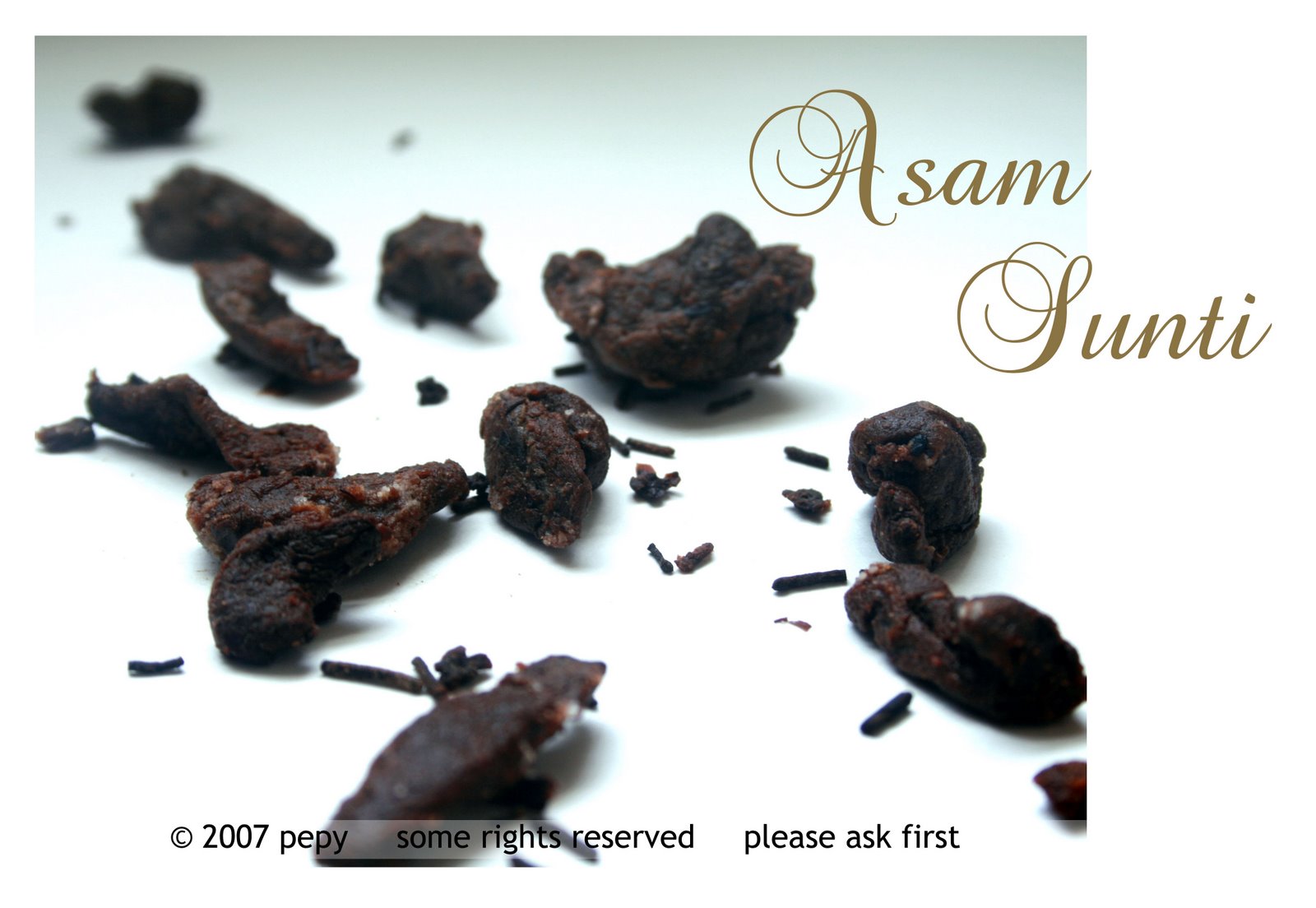
Cumi Tumis Aceh (literally translated Acehnese Spicy Squids) is a version of Cumi Teutumeh (literally Acehnese Squids in Spiced Coconut Milk) without coconut milk added. In this recipe, I added bilimbi as well as asam sunti (sun-dried bilimbi). As other Acehnese recipes, do not forget daun temurui or daun salam koja, which also known as curry leaves.


Bilimbi and this recipe are my entry for WHB (Weekend Herb Blogging) # 111, hosted by Kalyn. Since I can't find any fresh bilimbi for purchased, I have been using frozen bilimbi. You might find them in vegetable freezer at Asian groceries. If you notice on my bilimbi package's label, it is said kamias, that is in bilimbi's name in Tagalog.


Cumi Tumis Aceh


Ingredients:
500 g cleaned squids, cut as desired
1 lime
salt as desired
8 curry leaves
3 kaffir lime leaves
1 lemongrass, bruised
2 shallots, finely sliced
125 ml water
salt and sugar as desired to season

Grind into a paste
4 shallots
2 cloves garlic
5 dried red chillies
5 bird's eye chillies
10 asam sunti (sun-dried bilimbi)
3 bilimbis (Indonesian: belimbing sayur, belimbing wuluh)
3/8 - 1/2 tsp ground cumin
3/8 - 1/2 tsp ground turmeric
1 tsp coriander seeds
1/2 tsp ground white pepper

Directions:
1. Squeeze and drizzle lime over squid and sprinkle with salt. Add 1 - 2 tbsp spices paste, mix and let stand for 30 minutes.
2. Stir fry shallot slices, the remain spices paste, curry leaves, kaffir lime leaves, and lemongrass until fragrant.
3. Add squids mixture. Season with salt and sugar.
4. Add water; cook at medium heat until spices absorb and the water evaporates.
» Read More...