Siomay Bandung (Bandung Style Steamed Dumplings with Peanut Sambal) Recipe

Siomay Bandung
From the name siomay, you can tell this food had an influence from the Chinese who immigrated to Indonesia long time ago.  A word of siomay itself is derived from shaomai (also spelled shui mai, shu mai, sui mai, sui maai, shui mei, siu mai, shao mai, siew mai or siomai), the traditional Chinese dumpling.  Siomay (or Somay) has an ice cream cone shape, except the bottom is flat.

This kind of dim sum is a popular meal in Indonesia as a street/hawker food.  The difference between Chinese traditional dimsum with the Indonesian is the sauce.  We enjoy siomay with peanut sauce that has a kick from chili and drizzle with citrus juice (usually from jeruk limo (aka nasnaran mandarin or leprous lime) or jeruk purut (aka kaffir lime).

Most Indonesians use king mackerel fish (ikan tenggiri) meat for the filling.  But, you can find other filling variants such as shrimp or chicken or different type of fish.  For my recipe, I used featherback fish (ikan belida) paste.  Ikan belida was traditionally used by Palembangese (South Sumatrans) for making kerupuk (crackers), pempek (fish cake with tamarind sauce) and otak-otak (grilled fish cake wrapped in banana leaves).   I'm attaching the picture of ikan belida paste below.

Other complements to siomay bandung are hard boiling eggs, afilled cabbage, potatoes, bitter melon, and tofu.

As some of you know that I'm not a big fan of hard boiled eggs, I never add them to my plate.  In this case, I totally forgot to buy fresh tofu and potato, so I used tofu puffs and skipped the potato.

Note: I slightly change the NCC's recipe to my liking.  I used almost all roasted ingredients.   Find the tips for making easier sambal kacang below the recipe.

Siomay Bandung
-Bandung Style Steamed Dumplings with Peanut Sambal-
recipe by NCC (Natural Cooking Club), modified and translated by me
Ingredients:
500 g featherback fish (ikan belida) paste -> can be substituted for other white fish or shrimp or chicken
2 tsbp shallots, grated
1 tbsp mashed roasted garlic -> NCC: grated garlic
2 tsp ground white pepper
1 tsp dried shrimp (ebi), ground -> NCC: chicken bouillon
1 tsp fish sauce -> my idea
2 1/2 tsp sugar
2 tsp salt
1 tsbp sesame oil
3 eggs
400 g chayotte or jicama, shredded
450 g tapioca starch

round wonton skins
bittermelon
cabbage
tofu puffs


Featherback Fish Paste - Pasta Ikan Belida
Featherback Fish (Ikan Belida) Paste


Sambal Kacang (Peanut Sambal)
400 g garlicky roasted peanuts
100 g garlicky roasted cashew nuts
150 g red cayenne pepper (reduce the amount to your liking), roasted
3 cloves roasted garlic, mash with a spoon
2 tbsp canesugar vinegar
2 tbsp salt
7 tbsp coconut sugar (gula jawa, gula merah)
500 g baked sweet potato (about 2 regular size sweet potatoes), peeled
1.5 L water

Methods:
1. In a big bowl, combine fish paste with shallot, garlic, white pepper, dried shrimp, fish sauce, sugar, salt and sesame seed oil.  Then add egg and mix well.

2 Add chayotte or jicama, mix well. Add tapioca starch and mix well again. Set aside.

3. Steam all of these below for about 20-30 minutes. Grease the steamer with very small amount of oil if you need, so the dumplings won't be sticky.

--> Siomay:
Take one piece of the wonton skin, scoop 1 tbsp of filling on the centre of the skin. Shape the siomay using hands and leave the top open. Repeat the step until all wonton skin are used up. Steam for 20-30 minutes.

--> Tofu and Potato Soybean Cake & Potato:
Cut in half and scrape a portion of tofu & potato side and fill it in with the filling. Do the same step if you use tofu puffs.

--> Bitter Melon
Cut in 3 to 4 pieces. I cut up to 5 pieces since the bittermelon size is quite bigger here. Scrape the seed portion and fill it in with the base filling.

--> Cabbage:
Many recipes suggested to dip the leaves in to hot water for a few seconds since they don't fill the cabbage leaves with fish paste mixture. I prefer using the Ukrainian way of making holubtsi (cabagge roll). Steam the whole head of cabbage until soften. Cut the leaves off of the cabbage and cut the larger leaves in half. Spoon 1 tablespoon of filling into a leaf and roll tightly. Place rolls in a prepared casserole dish. Ready for steaming.

--> Egg
Hard boiled eggs split in half, paste on a mixture of fish.

Sambal Kacang (Peanut Sambal)
1. Process peanuts and cashew nuts in a food processor until smooth (I like a bit crunchy, everyone who loves smoother texture can process a bit longer). Transfer into a bowl. Set aside.

2. Process red cayenne pepper and garlic until smooth. Add sweet potato and process again. Add ground nuts; process. Add salt, vinegar, sugar and combine again. Do a taste test, if it's perfect for your tastebuds then it's ready to serve.

Seving suggestions: place all dumpling on a plate, cut to bite sizes if you like. Add peanut sambal and drizzle over the juice of leprous lime or kaffir lime, kecap manis and ketchup. I usually serve another side of chili sambal if people want to have more heat.

Tips:
* Use ready to use natural peanut and cashew butter from a store.  I like using the natural ones since there is no other additions beside the nuts and salt.  Some natural health stores in Winnipeg offer a service for us to grind the unsalted roasted peanuts that we buy there.

*In this recipe, I made my own garlicky roasted peanuts and cashew nuts.  Soak the nuts in warm water with lots of mashed garlics, add a bit of salt if you like.  Leave them overnight.  The next morning, drain them and roast in a pan with extra virgin coconut oil (add just enough, don't put too much).  Before the nuts turn golden brown (about a half of roasting time), add garlic slices.

* You can always roast the cayenne pepper with the whole head of garlics.  If you have a left over roasted garlic, you can apply for your toast or spice up others foods.
» Read More...

Fried Bihun ala Old Jakarta Kota Station

Fried Bihun, Vegetable Fritters and Peanut Sambal

Bihun or rice vermicelli often uses in Indonesian recipes. Wiffy's post, fried bee hoon has reminded me of this old time snack.

It was the time whenever my destination was Jakarta Kota aka Beos, an old area of Jakarta with heavy inhibited by Chinese descendant, I bought this fried bihun.

As I resided in Bogor, I had to take a mass transit (train) to go to there. Once I arrived at the Jakarta Kota station and got off of the train, I saw many food sellers, including the noodle ladies.

The sellers offered three kinds of nooddle; mie (egg noodles), bihun (rice vermicelli), and kwetiau (rice noodle). The fried noodles were not complete without choices of fritter and sambal kacang (peanut sambal). The fritter choices were risol (spring roll filled with rice vermicelli), fried tempe, tahu isi (breaded stuffed tofu) and bala-bala or known also as bakwan (vegetable fritters).

The proper way to eat them is place the noodles, cut any fitters into bite size and pour the spicy peanut sambal over.

I knew they are not the most healthiest food on the planet. But heyy, I was a student at that time with a tight budget :). Those food were delicious and cheap.

Today, when I posted the pic on my facebook. One of friends commented that there are no longer fried bihun sellers at the Jakarta Kota station. :(

Bihun Goreng, Sambal Kacang and Bala-Bala
- Fried Bihun, Peanut Sambal and Vegetable Fritters -


Ingredients:
Bihun Goreng (Fried Bihun)
250 g dry rice vermicelli, soak in cold water until soften and drain
100 g cabbage, roughly sliced
2 tbsp ground ebi* (can be substituted for fish sauce)
kecap manis (Indonesian sweet soy sauce)
mushroom soy sauce (regular soy sauce will be fine)
salt as needed

spices to be ground:
3 garlic
3 shallots
white peppercorn
oil for stir-frying

Sambal Kacang (Peanut Sambal)
3 tbsp roasted/fried peanuts
3 roasted/fried red cayenne pepper
3 roasted/fried bird eye chilies
sugar
salt
canesugar vinegar (Indonesian: cuka lahang)
a small amount of water

Bala-bala (Vegetable Fritters)
adapted from Dapur Bunda, modified by me
125 g rice flour
25 g tapioca starch
1 egg
100 ml cold water (4 degrees Celsius)
100 g cabbage, finely sliced
100 g julienned carrots
50 g bean sprouts
1 green onion, sliced
oil for deep-frying

Spices to be ground:
2 candlenuts
2 garlic
1 shallot
1 1/2 tsp white peppercorn
1 tsp seasalt

Note: *Ebi is an Indonesian term for dried shrimp

Directions:
Bihun Goreng (Fried Bihun):
1. Combine kecap manis, soy sauce and rice vermicelli.
2. In a wok, add oil. Stir fry ground spices for a minute.
2 Add cabbage and ebi.
3. Add bihun mixture and salt if you need. Mix. Remove heat and set aside.
4. Serve with fritters and sambal kacang.


Sambal Kacanng (Peanut Sambal):
In a blender, process peanuts, cayenne pepper, chilies, salt, sugar, water and vinegar until smooth.

Bala-Bala / Bakwan (Vegetable Fritters): 
1.  In a bowl, stir in flour, egg and water until smooth
2.  Add ground spices, and stir well.
3.  Combine vegetables and stir well.
4.  In a pan/wok, heat up oil at medium-hot.  Using a tablespoon, do a spoonfull of batter, add into hot oil and fried until dry and cooked.
5.  Remove from hot oil and drain with brown paper bag to absorb more oil.
» Read More...

Deep Fried Shrimp ala Bie Fong Tong - Super Duper Garlicky Deep Fried Shrimp

Deep Fried Shrimp ala Bie Fong Tong

Udang ala Bie Fong Tong or Deep Fried Shrimp ala Bie Fong Tong.  One of Indonesian bloggers, cik Ine popularized this recipe in 2006.  At that time, I still blogged on multiply where I met her and saw the recipe.  As she mentioned at her blog, this recipe was introduced by chef Pieter of Lai Ching Chinese Restaurant at the Four Seasons Hotel in Jakarta.  Original recipe has published on the detikfood.com website.

Thanks to cik Ine for her creativity by adding more fried chopped garlic in it, so I can call this Deep Fried Shrimp with 3-4 Bulbs of Garlic or Super Duper Garlicky Deep Fried Shrimp. Additionally, Anit, my facebook's friend called Anti Vampire Deep Fried Shrimp�.  Ok, the trademark sign was just a joke.

I made this recipe for the first time  in 2006 as well.  I made it again and again whenever I was lazy and got stuck what I supposed to do for cooking the shrimps. You also know that I like to modify the recipe to adjust what I have in the pantry and my taste-buds. In this recipe, I reduce the corn starch and egg.  Plus, I didn't deep fried the chopped garlic instead I baked them in the oven with oil.

Warning: Be ready to use 3-4 bulbs of garlic or buy a jar of fried garlic ready to use at the Asian stores. Super Duper Garlicky!

Udang ala Bie Fong Tong
- Deep Fried ala Bie Fong Tong - Super Duper Garlicky Deep Fried Shrimp -
Recipe by Chef Pieter, modified by Ine Elkaje and me

Ingredients:
454 g (1 lb) black tiger prawn/shrimp, peeled and deveined, but leave the tails on
ground white pepper
seasalt
1 egg, beat until peaks (original recipe called for 2 eggs)
100 g corn starch (original recipe called for 150 g)
2 - 3 bird eyes chillies, finely sliced
2 cloves garlic, bruised, to stir fry
vegetable oil

Sprinkle
200 g or 3-4 bulbs of garlic, chopped
1 green onion, finely sliced

Directions:
Bie Fong Tong style fried garlic for sprinkle
1. Clean and drain off the chopped garlic, sun-dried the garlic to reduce the moist (I used the oven to dry off).
2. Bake the garlic with a small amount of oil or deep fry until crispy and golden brown.
3. Garlic ready to use as Bie Fong Tong seasoning

Deep Fried Shrimp ala Bie Fong Tong
1. Sprinkle salt and pepper over the shrimp, combine.
2. Sprinkle with a small amount of corn starch, combine.
3. Add beaten egg, combine.
4. Coat the shrimp with the rest of cornstrach.
5. Deep-fry the shrimp until golden brown. Set aside.
6. Heat oil in a skillet over medium heat. Stir fry the bruised garlic and bird eyes chillies until fragrant. Add the deep-fried shrimp, stir. Add fried chopped garlic, green onion, black pepper and salt, stir. Remove from heat and serve.
» Read More...

Too Late to Say Gong Xi Fa Chai?

Phoenix Talons - Day 15 of 365

When I was 13 years old, our family moved to a residential area that had more Chinese descendants. My dad decided to move there since his work was remote to Surabaya.

In that area, I had more opportunity to know their culture, including the food. Take a look Tuty's blog, she mentioned all the goodies that I used to get from my neighbours when they celebrated Chinese New Year.

After graduating from high school, I moved to Bogor to continue my education where I met my good friend who has mixed blood of Chinese, Javanese and Sundanese. I recalled we loved to collect Chinese accessories and see barongsai (Lion's dance). Not only that, we love to eat noodle, Sundanese food and fish head.

Ohh well, time goes by so fast. I miss that old time! Not to mention that I got the day off because Chinese New Year is a public holiday in Indonesia. I know I am to late to say "Gong Xi Fa Chai" or "Selamat Tahun Baru Imlek" or Happy Chinese New Year.
» Read More...

Smoked Duck Fried Rice

Smoked Duck Fried Rice

This smoked duck was leftover from our New Year's dinner. My uncle in law asked a help his colleague to smoke a whole duck. After the dinner, he then left the carcass, fat, skin and some meat for me to bring home. I baked the fat and skin to get the oil. With some vegetables, I boiled the carcass for the broth. Used the meat for this fried rice. Look! I used up almost everything...

I never have an exact recipe for fried rice since I have been making fried rice so many times.


Smoked Duck Fried Rice
recipe by me


Ingredients:
overnight cold cooked rice
smoked duck meat, sliced
shrimp
Chinese celery leaves, chopped

Grind into a paste:
shallots
red pepper
bird eyes chilies
dried shrimp paste(Indonesian: terasi)/fish sauce
candlenuts
white peppercorns

Directions:
In a skillet, saute the paste for 1-2 minutes or until fragrant. Add shrimp, stir. Mix cold rice in the skillet, stir until all mixed. Add smoked duck meat and chopped celery leaves and stir.

Serving suggestion: transfer into a plate, and ready to eat with fried egg and blanched vegetables.

» Read More...

Bubur Ayam - Chicken Rice Porridge

Bubur Ayam - Chicken Rice Porridge


Bubur Ayam or Chicken Rice Porridge is a breakfast style of people who live in western part of Java island in Indonesia. I used to consume this once I moved to Bogor.

To get the sense of street food hawkers in Indonesia, I purposely looked for the specific bowl. A bowl with cock's pattern which is widely used for the food hawkers to serve bakso (meatballs soup), bubur (rice porridge) and mie ayam (a noodle dish with savoury ground chicken. I was so happy to see this bowl for purchased at one of Asian grocers in Winnipeg.

I care less about chicken innards sate that is complement for bubur ayam, so my choice was yellow chicken sate as the substitute here. The recipe was adapted from Bubur Ayam Sukabumi - Sukabumi Style Chicken Rice Porridge. Somehow, I played around and not really followed the directions.

Bubur Ayam
-Chicken Rice Porridge-
modified by me

Ingredients:
Rice Porridge
200 g rice
1 L water
2 L homemade chicken stock (I used leftover chicken carcass and veggies to make stock)
1 pandan leaf
2 Indonesian bay leaves

Yellow Chicken Sate:
300 g chicken chunks
skewers

Grind rempah (spices) into a paste:
5 shallots
3 cloves garlic
2 cm length turmeric, roasted and peeled
1/4 tsp ground nutmeg
1/4 tbsp ground coriander seed
3 candlenuts
ground white pepper and salt as desired

Complements:
sambal
emping nut crackers.
tapioca crackers
cakwe (Chinese long donut), sliced => for people who live in western Canada, it can be found at Superstore (bulk bakery section). Also, sold frozen at Asian grocers.
fried soybeans
fried shallots
Chinese celery leaves, chopped
green onions, sliced


Directions:
Rice Porridge
1. Wash and drain the rice. In a pot, mix water and rice. Bring to a boil and cook until soft.
2. Add chicken stock and the leaves. Reduce the heat and continue simmering until porridge is ready. No separation between liquid and rice is the sign that porridge ready. Add salt and ground white pepper to taste and mix.

Yellow Chicken Sate
1. Stir fry rempah until fragrant. Add a small amount of water and chicken chunks. Cook until the liquid evaporates.
2. Thread the wooden skewers onto chicken chunks. Grilled until done.
Yellow Chicken Sate


How to fry soybeans to perfection: (courtesy of Mariena of Resto Mariena)
Soak soybeans in hot boiled water. When the water's temperature is low or colder, drain soybeans. Place on paper surface to speed up the drying process. Fry until golden brown. Drain and store in an air tight container.

Plating the bubur ayam:
Place bubur (rice porridge) in a bowl. Sprinkle fried soybeans and shallots, green onions, chopped celery leaves, tapioca and emping nut crackers. Put sambal on the spoon.
» Read More...

For the Love of Dim Sum - Phoenix Talons a.k.a Fenghuang Claws

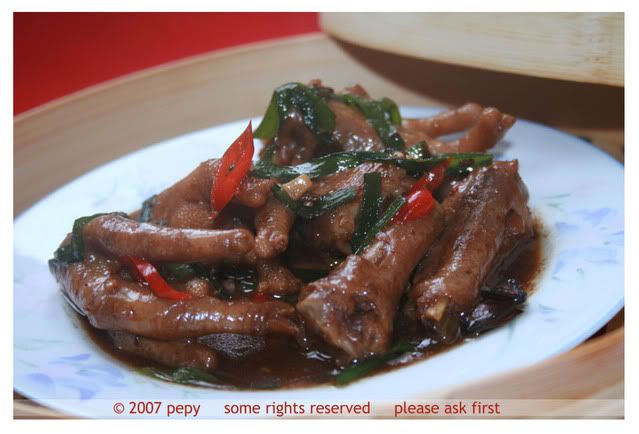
Phoenix Talons

My beloved mom used to tell story on how I grew up, "when you were a baby and your teeth would grow, just like other babies, you loved to bite everything as you had an itchy gum. Instead of seeing you biting the toys, I gave you boiled chicken feet. At least, there is calcium in them." Added chicken feet into regular vegetable soup and sayur asam (Indonesian sour vegetable soup) is also my family's tradition.

What do I look for whenever I go to dim sum restaurants, either in Canada or in Indonesia? Phoenix Talons a.k.a Fenghuang Claws or the Indonesians call "Angsio Cakar Ayam".

Snow has come about a week ago. It is getting cold and colder each day. Dim sum dish is one of my perfect food for the cold days. Since I have a package of red yeast rice that I bought about a month ago from one of the Asian stores in Winnipeg, I was tempting to try chicken feet with dim sum style.

The mistake that I made I didn't follow mbak Ruri's recipe by not soaking the chicken feet in icy cold water after deep frying. Thus, my chicken feet were not puffy enough as the dim sum style. However, I put down mbak Ruri's recipe so you can follow it.


Phoenix Talons // Angsio Cakar Ayam
recipe by Kueh Ruri and Rossy of Rossy Kitchen, modified by me


Cakar Ayam photoset2


Ingredients:
1 kg chicken feet, discard the nails

Ingredients A. :
5 cloves garlic, bruised
3 star anises
4 cm length ginger, thinly sliced
3 green onions, take the white part only and cut into 2 cm length
1 tbsp oyster sauce
2 tbsp light soy sauce
2 tbsp mushroom soy sauce
3 tsbp raw sugar
� tsp ground white pepper
1.5 liter water
1 tbsp red yeast rice (Indonesian: angkak)

Ingredients B:

1 tbsp minced garlic
3 long red chilies, angle cut
3 tbsp black bean sauce (Indonesian: tausi)
2 tbsp rice wine (I don�t use this)
2 tbsp sesame oil
2 tbsp cornstarch, dissolved in a small amount of water
the green parts of green onions from ingredients A


Cakar Ayam photoset

Directions:

Deep fry chicken feet until done, remove from the fryer and transfer into a big bowl fill with icy cold water. Soak for 3 hours or so.

Steps A.

1. Stir fry garlic until fragrant, add water and the rest of ingredients A.
2. Bring into a boil. Add chicken feet, cook until the chicken feet soft, the spice permeates and the water evaporates.
3. Remove from the heat.
Steps A will be faster if you use a pressure cooker.

Steps B.

1. Stir fry garlic until fragrant, add black bean sauce and long red chilies; stir evenly.
2. Transfer the cook chicken feet, rice wine and add cornstarch mixture; stir evenly.
3. Add sesame oil and green part of green onions, stir and remove from the heat.

» Read More...

Lumpia Semarang // Semarang Style Spring Rolls


Lumpia Semarang is known as a street hawker food in Indonesia that you can get everywhere and cheap. It is served with brown sauce and cucumber shallot pickle. This recipe was modified from an Indonesian cookbook "Seri Menu dan Resep Menu Istimewa 2" by Yasaboga.

There are several version of Lumpia in Indonesia. Lumpia Semarang is one of the popular lumpia in the country. Semarang itself is a name after the capital city of Central Java province. In addition, lumpia's term derives from lunpia in the Hokien dialect of Chinese.

Bamboo shoots are always known as the filling of this lumpia, and my alteration version has been augmented by abalone sauce.

Lumpia Semarang
recipe by yasaboga team
modified by me

Ingredients:
15 sheets spring roll warpper (size 215 mm x 215 mm)
500 g shredded/chopped fresh bamboo shoot
500 g peeled shrimp, chopped
2 tbsp ground dried shrimp (Indonesian: ebi)
5 cloves garlic, minced
1 tsp ground white pepper
2 tbsp abalone sauce*
1 tbsp oyster sauce
1 tbsp mushroom soy sauce (original recipe called for soy sauce)
1 tbsp Indonesian sweet soy sauce (kecap manis)
400 ml homemade shrimp broth
3 tbsp oil for stir frying

Brown sauce
250 ml water
6 cloves garlic, minced
85 g coconut sugar, shredded (Indonesian: gula merah; original recipe called for 100 g coconut sugar)
1/2 tsp salt
1 tbsp tapioca flour dissolve in a small amount of water


Directions:
Brown Sauce
In a saucepan, bring water, coconut sugar, salt and garlic to a boil. Thicken with tapioca flour mixture, stir until mixed. Remove from heat and set aside.

Lumpia
1. Cook bambo shoot with water and 1 tbsp sugar until boiled, drain. Stir fry garlic until fragrant, add shrimp, bamboo shoot, ground dried shrimp, abalone sauce, oyster sauce, mushroom soy sauce, kecap manis, white pepper and salt. Add broth, cook until water evaporates.

2. Place 2- 3 tbsp filling on the wrapper. Fold over the corner that faces away from us. Brush brown sauce onto this corner for gluing. Fold over the left-facing and right-facing corners. Roll the lumpia toward us, onto the remaining corner of the wrapper. Examine the wrapper to ensure that it is fully sealed. Do until all filling and wrappers done.

3. Deep fry until golden brown.

* Abalone sauce is a high-grade seasoning extracted from abalone. It is an indispensable seasoning for various abalone-taste cuisines. It can also be used to dip, fry and cold dress vegetable, seafood or meat.


Abalone Sauce

Lumpia Semarang - Semarang (Indonesian) Spring Rolls on FoodistaLumpia Semarang - Semarang (Indonesian) Spring Rolls
» Read More...

Happy Hour at Dim Sum Garden

Last Saturday (March 29, 2008) was only 2C, but it had sleeted as you can see in the first picture, the road was so nasty. I was quite upset with the pictures here. It was my mistake too, I was in rush to take the pictures *too hungry:-P*. Also there was a dish that I didn't take a picture of, it was shrimp on green peppers with oyster sauce.

Gate to Chinawtown of Winnipeg

After I took pictures couple times, one of the servers came and asked me, " are you a professional photographer?"
I said, "Is there any rule that we can't take a picture here?"
"We are not allowed a pro photographer to take some pictures here."
"Ooo, no, it's just a hobby"
Hahahahahaha but I would say yes if he said we need a food photographer :-P

Another thing that was disappointed me, my favorite chicken feet came late, they put them on the cart right after we were standing front of the cashier to pay. :(

The only two places for dim sum in Winnipeg that I have been, are Kum Koon Garden and Dim Sum Garden. Kum Koon is pricey but if you look for a good food for Chinese food, it is the place. If you want to go for dim sum that is more modestly price than Kum Koon, go try Dim Sum Garden during their happy hour (2 pm to 5 pm).

Dim Sum Garden
277 Rupert Avenue
Winnipeg, MB R3B 0N5
(204) 942-8297

Enjoy the pictures folks!

Red Baby Octopus

Squids
Bean Curd 1
Bean Curd 2

Shrimp and Scallop Dumplings
Shrimp and Scallop Dumplings or we call Hakau in Indonesian

Fried Stuffed Eggplants
Fried Eggplants Stuffed with Shrimp

Shrimp in Eggplants

Gai-lan with Shrimp Paste Sauce

Gai-lan with Shrimp Paste Sauce (Petis Udang in Indonesian)

Next are two pictures of my favorite mango pudding.
Mango Pudding 1

Mango Pudding 2

Dim Sum Garden on Urbanspoon
» Read More...

Bihun Jamur Shittake // Shittake Rice Vermicelli

After having some Western style food, I miss my Asian food style. Last night, I browsed around Tabloid Nova, a women tabloid in Indonesian. I found a recipe of Kwetiau (English: wide rice noodles). I had all the ingredients, except Kwetiau, but I had bihun (English: rice vermicelli). I substituted for bihun and added mushroom soy sauce in.

It was quick to make so my husband could bring for lunch today.


Ingredients:
150 g rice vermicelli
3 tbsp oil
1 can flaked tuna in water, drained
2 tbsp sesame and soy oil ( you can use regular sesame oil)
4 red chilies, discard the seed and angle cut
1/4 cup frozen ground lemongrass (original recipe uses 1 fresh lemongrass, then finely sliced)
8 green onions (original recipes uses kucai or Chinese chives or nira chives), cut into 4 cm length
250 g fresh shittake mushroom, sliced
3 cloves garlic, minced
3 tbsp ketchup
1 tbsp mushroom soy sauce
1 tsp ground white pepper
Directions:
1. Bring water to boil and remove from heat. Add rice vermicelli and soak for 1 minute. Drain, add 1 tbsp sesame and soy oil and mix well.
2. In a skillet, combine oil with 1 tbsp sesame and soy oi; heat up at medium- high. Saute garlic, lemongrass, red chillies, and mushroom; stir evenly. Add tuna, green onion, ketchup, mushroom soy sauce, white pepper; stir evenly.
3. Add rice vermicelli, combine until well-mixed. Remove from heat and transfer into serving dish. Sprinkle fried shallot over.
» Read More...

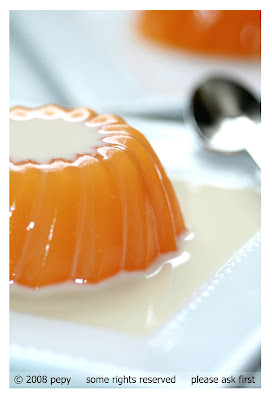
[WHB] Konyaku and Mango Orange Pudding

Have you ever heard about konyaku, shirataki or iles-iles before?  Konyaku is a traditional Japanese jelly-like health food made from a kind of potato called "Konnyaku potato" and calcium hydroxide or oxide calcium extracted from eggshells.  I my self didn't know that konyaku potato and iles-iles were the same plant, which I heard about iles-iles before when I was in school. The konnyaku potato (Amorphophallus sp.) is native to Indonesia.  Amorphophallus sp goes by several unflattering names in English (Devil�s tongue, Voodoo lily). In Japan , this plant is cultivated for food purpose only, but wild forms grow naturally in Southeast Asia and China.

Many of our modern foods are acid foods.  Konnyaku, on the other hand, is a uniquely alkaline food. It is said that modern people had better eat more alkaline food in order to keep healthy. Therefore, Konnyaku is an ideal health food for us.

Through this website, I found so many benefits in konyaku.  Konnyaku is a marvellous health food and an ideal food for weight control and prevention of obesity because low in calories, no fat, rich in mineral and full of dietary fibre.  It means it helps maintain our health and ultimately, it prevents against bowel cancer and haemorrhoids.  I also found in this website, that iles-iles a.k.a konyaku potato is also added for smoothing skin looking in cosmetic industry.   If you want to see the plant's picture, please go visit http://www.humanflowerproject.com/index.php/weblog/comments/563/ , http://food.3yen.com/2007-09-04/konnyaku-jelly/ .

I had been craving for mango pudding since I saw Pippi�s post.  It reminds me of mango pudding at dim sum restaurants which is served by pouring evaporated milk on top.  I remember I still have several package of unflavoured and flavoured konyaku powder, also unflavoured agar-agar powder that I bought when I was on vacation to Vancouver.  While I was looking for my konyaku powder in my pantry, yayyy I had the mango flavoured one .

Mango Flavoured Konyaku Jelly Powder


Asian pudding is slightly different with Western pudding. In Indonesia, pudding�s recipes is used unflavoured or flavoured agar-agar powder or konyaku powder, which has similar texture to gelatin.


Agar-Agar Powder

I prefer use the fresh mango than canned mango. Good thing! I saw fresh mangoes were on sale at the store. I still had 3 fresh oranges, might as well combined those fruits together. Recipe was modified from Pippi's recipe. Thank you, Pi!

Konyaku's information and mango orange pudding is my entry for Weekend Herb Blogging this week, hosted by Ulrike of Kuchenlatein.


Mango Orange Pudding
modified from Cerita Pippi's recipes


Ingredients:
1 1/2 fresh ripe mangoes, peeled, discard the pit and chopped; yield about 500 g.
3 fresh oranges, grate the skin, squeeze, you will get about 1/4 cup of combining orange juice with pulp and orange zest
1 package mango flavoured konyaku powder ( I used Indonesian brand �Nutrijell�), this package will come with fruity acid powder*
1 package unflavoured agar-agar powder (I used Indonesian brand �Bola Dunia�)
� cup sugar (you can add more sugar if you like sweet taste)
1200 ml water

evaporated milk for the sauce


Directions:
1. Blend mangoes, orange juice and pulp, orange zest and sugar together until smooth in a blender.
2. In a medium pot, add water, blended fruit mixture, unflavoured agar-agar powder, mango flavoured konyaku powder. Bring to boil and stir ocassionally until done. Remove from heat. Let stand for 3 minutes, add fruity acid powder, and stir until dissolved.
3. Wet jelly molds with water before using. Pour into prepared jelly molds. Cool down until set, unmold puddings, place on dessert plates and pour evaporated milk on top.

*Fruity acid powder is optional, you can add into or just omit it.

Source of Konyaku's information
-
http://www.shakespeare-w.com/english/konnyaku/whatis.html
-
http://iptek.apjii.or.id/artikel/pangan/IPB/Iles-iles.pdf
» Read More...

Cold! Windy! Hot and Spicy! Soupy!


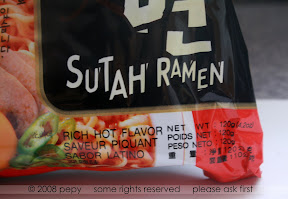
Last Wednesday was so cold, windy, -47 degrees Celcius. The good part, I was off as my schedule so I didn't have to go work. That kind of temperature makes me always crave for Asian style hot and spicy soupy noodles. I picked to try Sutah Ramen, another favorite of Korean instant noodle. I used to have Neoguri seafood or kimchi udon. The biggest reason why I love Korean instant noodles? It's spicy hot without adding more hot sauce, but for me I still add more chili powder not Indonesian hot sauce, I just don't want to ruin my soup taste.


I enjoyed this noodle with pangsit goreng (known as fried wonton in English). I made these pangsit goreng a month ago with homemade basa fish paste as filling then kept them in freezer.

» Read More...

Bakso Ikan Patin // Basa Fishballs

I didn't expect that bakso turned good. In Indonesia, people usually make bakso from king mackerel fish (Indonesian: tenggiri), but so far I have tried two different fish to make bakso, mullet (Indonesian: belanak) and this basa hypophtalmus (Indonesian: patin siam; scientific name: Pangasius hypophtalmus).

Especially for this basa, I have a different preparation by drizzling the fillet over with lime juice or calamansi juice and let stand for 15 minutes. From 500 g basa fillets, yield 30 fishballs.

Anyway, let's talk a bit about basa.
Basa is what the Indonesians are called for Patin. Here are some species of Basa/Patin that are found in Indonesia (according to http://www.bi.go.id/sipuk/id/lm/syariah/ikan_patin/pendahuluan.asp):

  1. Indonesian Local Patin with a scientific name Pangasius spp. One of popular exported comodities is patin jambal (Pangasius djambal Bleeker), live in the big rivers in Indonesia. Patin Kunyit is another kind of basa that lives in the Riau's big rivers.O
  2. Pangasius polyuranodo (ikan juaro), Pangasius macronema (ikan rios, riu, lancang), Pangasius micronemus (wakal, rius caring), Pangasius nasutus (pedado) dan Pangasius nieuwenbuissii (ikan lawang) only live in the East Kalimantan's rivers.
  3. Patin bocourti (Pangasius bocourti) lives in the rivers in Vietnam, and exported comodity to North America, Europe and several Asian countries.
  4. Patin siam (Pangasius hypopthalmus) can be called for patin bangkok or lele bangkok in bahasa Indonesia.

Ingredients:
500 basa fillets, drizzle with lime juice and calamansi juice over, let stand for 15 menit, then rinse off with tub water
200 g arrowroot starch (Indonesian:
tepung garut); can be substituted for sago starch or tapioca starch as well
3 cloves garlic
2 tbsp ready to use fried shallot
1 1/4 tsp sesame oil
1 tsp ground white pepper
salt and sugar to season as desired
150 ml cold water (you can use ice cube)
ready to use broth (I used canned of vegetable broth that is sold at Asian markets)

Directions:
1. Heat up the broth to 80 degrees C, never get broth boiled and keep the temperature at 80 degrees C.

2. Process all ingredients, except broth in a food processor until smooth and well-blended.

3. Take a tablespoon of fishball dough and shape into ball. Put the ball into simmering broth and do this method until all mixture done. Cook the fishballs until floating.

4. Angkat bakso dan letakkan dalam mangkok berisi es batu dan air dingin
» Read More...

Chicken Feet with Black Bean Sauce

Photo Sharing and Video Hosting at Photobucket


If you go to Dimsum restaurants, you will see chicken feet on the menu. They usually add angkak (also known as Beni-koji, Hong Qu, Hung-chu, Monascus; Red Koji, Red Leaven, Red Rice, Red Yeast Rice, Xue Zhi Kang, Zhitai) to get red effect in the sauce. I made a different style by using black bean sauce (Indonesian: taosi/tausi) and omitting angkak.

Ingredients A:
500 gchicken feet, cleaned, rinsed off, and halvedpotong jadi dua
1 tbsp light soy sauce
2 tbsp mushroom soy sauce
1 sdm rice vinegar (can be substituted for regular vinegar)
2 star anises
500 ml broth (I used ready to use seafood broth)*

Ingredients B:
3 Chinese chives (Indonesian/Chinese: kucai, Vietnamese: he)
2 red chillies, sliced
3 cloves garlic, crushed and chopped
2 tbsp black bean suace
2 tbsp oyster sauce
1 tbsp sesame oil
1/2 tsp ground white pepper
1 tbsp mushroom soy sauce
1 tsp corn starch, dissolved in a small amount of water
2 tbsp oil for sauteing

* If your broth doen't contain any salt, you can add salt into ingredients B as well. Be very careful to add salt, due to the saltiness of black bean sauce.


Photo Sharing and Video Hosting at Photobucket

Directions:
1. Combine ingredients A together, except star anise and broth. Marinate for 30 minutes. Deep fry chicken feet until cooked/done.
2. Prepare a presurre cooker, add chicken feet, star anise and broth. Cook for 15 minutes. If you don't have a pressure cooker, just use a pot, but it will takes more time than 15 minutes.
3. Heat up a skillet at medium-high. Add garlic and stir fry until fragrant. Add chili and remain ingredients, except corn satrch mixture.
4. Transfer chicken feet mixture into the skillet. Bring to a boil and cook until done. Add corn satrch mixture to thickened.
» Read More...

Szechuan Eggplants

I do love eggplants, either raw or cook. Back then while I was in my home country, I used to dip my raw terong gelatik putih (English: thai eggplants) into sambal terasi (dried shrimp paste and chili sambal) or roasted the terong ungu (Japanese/Chinese eggplants) and ate them with sambal terasi and warmed rice or steamed them and served with spicy coconut milk what we call "Pecel Terong Surabaya". Ahhhh I forgot to mention another kind of eggplant that I used to have, we call that eggplant as rimbang or tekokak in English is known as tiny eggplants, which the Sumatrans love to add them in their gulai.

It's different with my husband, he loves cooked eggplants, but he does love other raw vegetables. One time, he told me a story on how he knew eggplants for the first time. When he was young, he went to try an eggplant dish at a Italian restaurant. He didn't like it until he tried another eggplant dish at a Chinese restaurant. He fell in love and until now, every time we go to the Chinese restaurants eggplants will be the first pick :)

A week ago, we went to Huang Pu River, a Chinese restaurant on Pembina Highway. We usually ordered Eggplants Casserole or Szechuan Eggplants. That restaurant offer two kind of eggplants dishes. One is the Cantonese style and another one is the Szechuan style. The Cantonese was cooked with salty fish and the Szechuan is the spicy choice. As I grew up with salty fish and I love salty fish, I was scared that he would not like salty fish, I told him to pick the Szechuan one. He said, "I think I want to try the salty fish, let me pick the Cantonese one."

The orders came and he tried the eggplants dish, he said, "I like the salty fish." I just smiled and felt glad that he likes it.

I bought eggplants couple days ago and since he loves cooked eggplants and I still hadn't used my hot bean sauce in the pantry. I tried to make Szechuan Eggplants, got the recipe from the internet. This recipe is slightly different from the internet's recipes. I used kecap manis (Indonesian sweet soy sauce) instead of combining soy sauce and sugar.

Some people saute or bake the eggplants with a small amount of oil or deep fry to make them softer before they combine and cook with other ingredients. I myself sauted them with water.

Szechuan Eggplants

Ingredients:
4 Japanese/Chinese eggplants
1 tsp chopped fresh ginger
4 cloves garlic, minced
1 tbsp hot bean sauce
1 tbsp kecap manis "Bango" brand (Indonesian sweet soy sauce "Bango" brand)
1 tbsp reduced sodium soy sauce
1/2 cup stock (I used shrimp stock from Knorr)
2 green onions, finely sliced
2 tsp sesame oil
sesame seed for garnish
1 tsp corn starch dissolves in 2 tsp water


Directions:
  1. Cut eggplant smaller pieces as desired.
  2. Saute with some water in a non-stick pan/wok, until soft. When soft, remove from pan.
  3. In a pan, at low heat, cook garlic, ginger, and hot bean sauce for a minute
  4. Add kecap manis, soy sauce and stock/water.
  5. Return eggplant to the pan and cook for about five minutes until garlic is soft and a sauce forms.
  6. If you like thicker sauce, you can add the corn starch mixture.
» Read More...

Soun Goreng Sayuran dan Udang // Fried Bead Thread Noodles with Vegetables and Shrimp

Zaldi (one of my multiply contacts) was wondering about a recipe of bihun goreng jawa that I posted 6 days ago on my multiply. He asked whether bihun is what he calls for sotanghun in the Phillipines. Since the Filipino community is the largest immigrant in Winnipeg, sometimes I know some Tagalog food terms and I explained to him that bihun is what the Filipinos call for bihon and sotanghon is what the Indonesians call for soun or suun.

We use soun sometimes for Indonesian meatballs soup or what we call for bakso.

Soun Goreng

Ingredients:
200 g bean thread noodles, soaked
4 cloves garlic, crushed
300 g medium-sized shrimps, peeled, tails intact
2 green onions
50 g shredded cabbage
50 g yuey choy, washed, cut as desired and blanched
2 tbsp oyster sauce
1 tbsp sesame and soy oil (you can use regular sesame oil)
2 bird's eye chilies, finely angle cut
5 tsp kecap manis (Indonesian sweet soy sauce)
1 tbsp reduced salt soy sauce
5 tbsp olive oil

Directions:


Soun Goreng


1. Heat the oil in a pan over high heat, stir fry bean threads until appears slick and shiny. Set aside.
2. Heat the oil in a skillet over high heat, add cabbage and shrimps. Stir until the shrimp has changed color.
3. Add chillies, green onions, oyster sauce, kecap manis, soy sauce, and sesame oil; stir evenly.
4. Add bean threads and blanched yuey choy, cook thoroughly until done. Remove from heat and serve.
» Read More...

Bihun Goreng Jawa // Javanese Style Fried Rice Vermicelli

Bihun Goreng JawaI had been craving for bihun goreng jawa since mbak Winda (one of my contacts on multiply) posted the pictures. Bihun or the Javanese call as Mihun is also known as rice vermicelli, rice noodles, or rice sticks.


It just reminded me of buying bihun goreng or bihun kuah from street food hawkers/vendors in Indonesia. In Jakarta and West Java areas, they usually have bihun goreng with pouring peanut sauce over before they eat. However, in East Java areas, they usually have this with biting bird's eye chilies.

As I posted on my multiply in bahasa Indonesia, everybody who lives in abroad, keeps asking me where I got those cute kerupuk tersanjung. Believe me, I didn't get those from any oriental store in Winnipeg, but two of my multiply's contacts who live in Indonesia, sent me a package, including fresh spices such as andaliman, asam gelugur, kencur etc.


Ingredients:
200 g dried rice vermicelli
150 g peeled shrimps, chopped
2 green onions, finely sliced
100 g yuey choi (sawi hijau in Indonesian), cut as desired
100 g sliced cabbage
1 tomato, diced
125 ml homemade shrimp broth (you can substitute for any kind of broth or water)
3 tbsp olive oil
kecap manis (Indonesian sweet soy sauce), as desired
2 eggs, beaten

Ground Spices :
3 shallots
2 cloves garlic
1/2 tsp dried shrmp paste (terasi in Indonesian, belacan in Malay)
1/2 tsp ground corriander seed
3 toasted candlenuts
sambal ulek as desired
salt as desired


Condiments:
Thin omelette
Fried shallots
Onion crackers (kerupuk bawang in Indonesian, I used kerupuk tersanjung, don't ask me why they gave a name kerupuk tersanjung)
Cucumber, shallot, and bird's eye chili pickled (Acar Timun Bawang Cabe)


Directions:
Acar timun bawang cabe:
1. Cut cucumber into julienned, add salt as desired; let stand for couple minutes.
2. After cucumber a bit soften, add shallots and bird eye's chilies. Add sugar and vinegar as desired. Toast until mixed evenly.

Acar


Bihun Goreng Jawa
1. Soak dried rice vermiceli with very hot water or as directed on the pacakge. Drain.
2. Make a thin omelette from 2 beaten eggs. Slice an omelette into length strips.
3. Stir fry ground spices until fragrant, add diced tomato, continue to stir fry untill all spices is cooked.
4. Add cabbage and shrimp, stir until shrimp has changed into pink color.
5. Add 125 ml shrimp broth and kecap manis; stir evenly. Add rice vermicelli, yuey choy, and green onion. Stir until all mixed and cooked
6. Transfer into a serving plate, add omelette strips on top and sprinkle fried shallot over. Serve with kerupuk bawang and acar timun bawang cabe. Selamat Makan!!!

» Read More...

Bakso Ayam Wortel // Chicken Carrot Balls

As my multiply contacts/readers, you might wonder how to make Chicken Carrot Balls that I posted the picture yesterday as condiment for Mie Jamur Pangsit Bakso. One you should remember this recipe is just my idea but absolutely worth to try. You can add into your soup or just eat the way it is by dipping in hot sauce or other sauce that you like.


Ingredients:
350 frozen ground lean chicken
10 peeled baby carrots
1 tsp garlic powder
1/8 tsp grated ginger
2 green onion, finely sliced
1/2 egg, beaten
salt and ground white pepper, as desired
sesame and soybean oil as desired
hagou flour (just because I didn't have any tapioca flour, so I used this flour instead, which is usually for making hakau/Chinese shrimp dumpling), depend on the consistency that you like

Directions:
Place chicken, carrot, garlic powder, ginger, green onion, salt, white pepper and oil in a food processor. Process until smooth.

Transfer into a bowl, add egg and flour, combine and knead until you get the consistency that you like. Roll the dough into balls

In a pot, add stock, when the stock starts to simmer (around 80C do not boil), add the balls. When the balls float to the top, it's ready. Drain and transfer into a bowl of cold water and ice cubes.

You can snack them with dipping into hot sauce.
» Read More...

My Comfort Food - Mie Jamur Pangsit Bakso

Never get bored of this food. Yeahh, this is one of my comfort food, Mie Ayam Jamur Pangsit Bakso (literally translate: Chicken Noodle with Meatball and Wonton Soup). Back then, I never made them by myself, it is easy to find in Indonesia, from street food vendors or hawkers to restaurants.

Summer in Winnipeg is insanely hot, the highest temperature of this summer is up to 50 degrees celsius with the humidity. Today was pouring which is good, it's cooled down the temperature. Rain always reminds me of Bogor, reminds me of Mie Ayam Jamur Pangsit Bakso at Mie Tasik on Suryakencana street.


I decided to make my instant Mie Jamur Pangsit Bakso. I didn't say Mie Ayam Jamur, coz I didn't add any chicken in Ayam Jamur (Chicken and Mushroom Stir Fry, see the recipe at here). I also made Bakso Ayam Wortel (Chicken and Carrot Balls) instead of Bakso (usually this term goes for beef balls in Indonesia), my pangsit (wonton) was filled with chicken and carrot balls dough. At this moment I didn't use tapioca starch or arrowroot starch for making bakso (bakso's recipe can be seen here), I used hagou flour which is usually used for making hakau/dimsum. For soup, I used to make it from chicken bones for broth, and today I made it from dashi stock dissolved in water. For the noodles, I used fresh wonton noodles that you can buy at any grocery or Asian store. Before serving, noodles should be cooked in boiling water for 3 minutes or until done. Blanch yuey choy (sawi hijau) or baby bok choy in boling water, drain and cooling them in cold water.


Serving Time... Place cooked noodles in a bowl, add chicken oil, salt, ground pepper, and Indonesian sweet soy sauce (optional if you want to make mie yamin, Indonesian mie ayam for sweet taste version, see the recipe at here). Today, I didn't use chicken oil, I just used sesame and soybean oil. Place Mushroom Stir Fry and bok choy on noodles. In another small bowl, place broth, bakso, pangsit, and sprinkle with green onion slices. Remember these all are only shortcut to get Mie Jamur Pangsit Bakso, not the authentic one.
» Read More...